In wearable cardiovascular health technology, few topics generate as much debate—and confusion—as the distinction between optical photoplethysmography (PPG) and electromechanical oscillometry. Consumer smartwatches frequently promote "blood pressure tracking" through optical heart rate sensors, yet healthcare systems, cardiologists, and remote patient monitoring (RPM) organizations consistently mandate cuff-based measurements.
This technical whitepaper provides a rigorous engineering comparison of the hemodynamic physics, transducer circuitry, mathematical signal processing, and mechanical failure modes distinguishing optical PPG from physical micro-pump oscillometric watches.
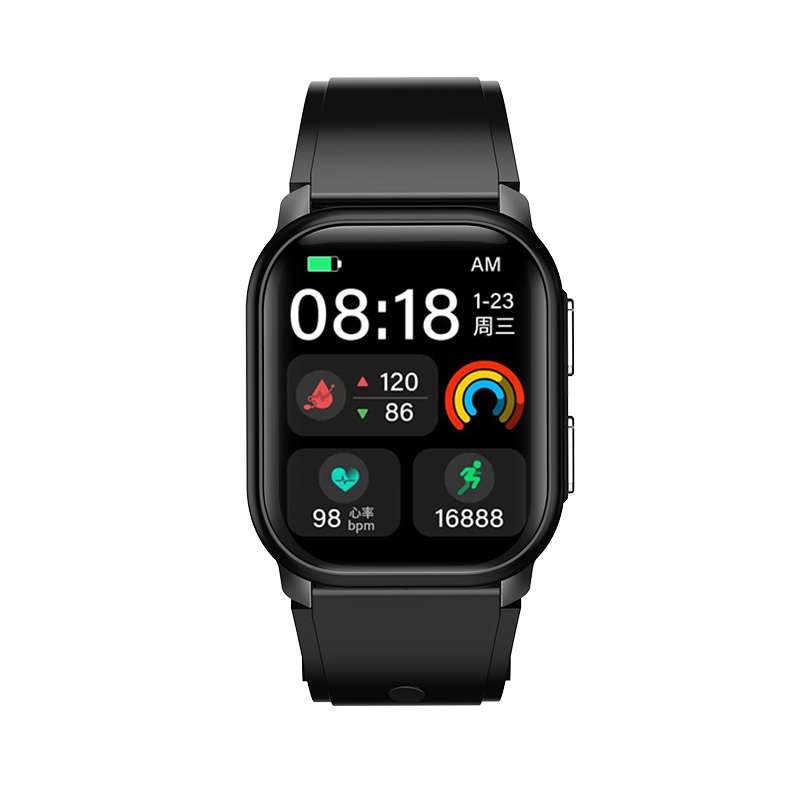
1. Hemodynamic Measurement Principles & The Moens-Korteweg Dilemma
To understand why optical smartwatches fail to achieve standalone clinical accuracy, one must examine the classical hemodynamic equations governing arterial pulse wave propagation. Optical blood pressure estimation relies on Pulse Wave Velocity (PWV) or Pulse Transit Time (PTT), mathematically described by the Moens-Korteweg equation:
Where:
- E: Young's elastic modulus of the arterial wall.
- h: Arterial wall thickness.
- D: Internal arterial diameter at rest.
- ρ: Blood fluid density (approximately 1.05 × 10³ kg/m³).
The relationship between blood pressure (P) and arterial elasticity (E) is modeled through Hughes' empirical exponential relationship: E = E₀ × e^(α × P). While this provides a mathematical pathway to infer blood pressure from pulse transit time, it exposes a critical flaw: E₀ (baseline elasticity) and α (vessel stiffness factor) are not static constants.
In human physiology, vascular compliance changes dynamically based on sympathetic nervous system tone, acute mental stress, ambient temperature vasoconstriction, peripheral vascular resistance, and long-term arteriosclerosis. Optical PPG algorithms calibrate these parameters against an external cuff at a single point in time. When vascular tone shifts hours later, the mathematical model breaks down, producing severe estimation errors—often missing dangerous hypertensive spikes entirely.
2. True Oscillometric Mechanics: The Physical Inflatable Airbag
True oscillometric measurement, governed by international clinical standards such as ISO 81060-2 and IEC 80601-2-30, operates completely independently of pulse wave velocity assumptions.
In a true oscillometric watch (such as the LUROGEF wrist blood pressure watch portfolio), measurement follows four distinct mechanical phases:
- Pre-Inflation Baseline: The pressure transducer is referenced to ambient atmospheric pressure through a vent before the measurement starts, so the trace begins from a known zero.
- Controlled Pressurization: Air is driven into the curved TPU bladder in the strap. The bladder expands against the volar aspect of the wrist and compresses the radial and ulnar arteries against the radius until flow is occluded. The pressure at which that happens varies by wearer; no target pressure is published for these models.
- Controlled Deflation: Air is released at a controlled rate while the pressure trace is recorded. The rate has to be slow enough for the oscillometric envelope to be resolvable; the slope actually implemented is not published for these models.
- Oscillation Waveform Extraction: As bladder pressure falls through systolic pressure, blood begins moving through the partly opened artery during each ventricular contraction, transferring small pressure oscillations into the bladder. The oscillations peak in amplitude near mean arterial pressure and decline below diastolic pressure — that envelope is what the algorithm reads.
| Architectural Dimension | Physical Micro-Pump Oscillometry | Optical PPG Pulse Wave Estimation |
|---|---|---|
| Measurement Paradigm | Direct physical arterial occlusion and pressure oscillation envelope. | Indirect estimation via optical absorption and pulse transit time (PTT). |
| Sensor Transducer | A pressure transducer read against the bladder. The specific transducer type used in these models is. | Green/IR optical LEDs and photodiode receptor arrays. |
| External Calibration Needed? | Measures pressure physically, so it needs no optical calibration. That is not the same as needing no validation: accuracy still has to be established for the target market. | Needs recurring calibration against a pressure reference to report an absolute value. |
| Impact of Skin Tone / Melanin | A pressure reading does not depend on optical absorption through skin. | Optical attenuation varies with skin pigmentation and can degrade signal quality. |
| Vascular Compliance Sensitivity | Immune to vascular elasticity drift; captures real-time oscillation peaks. | Severely distorted by arteriosclerosis, acute stress, or temperature. |
| Power Consumption Per Reading | Roughly 20–30 mAh for a motor-and-solenoid release cycle — an indicative range for the mechanism, not a measured figure for a specific model. | Under 0.5 mAh for low-power LED flashing — again an indicative mechanism range rather than a model measurement. |
Consumption figures are indicative ranges for the two mechanisms rather than measured benchmarks for a specific model. The chassis dimension quoted below is from our own model documentation.
3. Piezoelectric Micro Air Pump & Pneumatic Transducer Circuitry
Miniaturizing a medical air pump into a wearable watch casing (such as the 12.6 mm chassis of the VP20 rectangular watch) requires cutting-edge micro-electromechanical systems (MEMS) engineering.
Traditional sphygmomanometers use rotary DC motor pumps with eccentric cams and rubber bellows. Those assemblies are thick, audible and power-hungry, which is why wearable platforms use a different class of pump — a micro air pump driving a curved TPU airbag integrated into the strap. That much we can state about our own hardware.
Not established for these models: the pump's actuation principle, its operating frequency, the number and type of valves, the pressure ceiling, the inflation time and the deflation slope are all unestablished for these models. No approved manual exists for any of these models yet, so none of them is given an actuator material, a frequency, a pressure figure or a deflation rate. The mechanism classes below explain why a pump-based design behaves differently from an optical estimator — not because our own pump is documented as using any one of them.
- Actuator type: Wearable pumps are commonly driven by a piezoelectric diaphragm or a miniature motor; the two differ in noise, thickness and power draw. Which one a given model uses is not stated for these models.
- Acoustic behaviour: A pump driven above the audible range inflates quietly, which matters when a patient measures in public or at work. The actual noise level of these models is unmeasured here.
- Valve arrangement: Check valves hold pressure between pump strokes so the bladder can reach occlusion pressure. Valve count and construction are unestablished for these models.
- Deflation control: The pressure has to fall at a controlled, near-linear rate for the oscillometric envelope to be readable. The deflation slope actually implemented is unmeasured here.
4. Optical PPG Failure Modes: Skin Pigmentation, Motion & Temperature
Biomedical engineers must evaluate why optical PPG fails clinical rigor in unconstrained ambulatory environments:
Optical Absorption & Melanin Filtering
Green light (wavelength ~525 nm) exhibits shallow tissue penetration (less than 1 mm), interacting primarily with superficial capillary beds rather than deep muscular arteries. Epidermal melanin absorbs green photons heavily. In patients with darker skin pigmentation (Fitzpatrick scale IV–VI), signal-to-noise ratio (SNR) drops precipitously, forcing algorithms to amplify sensor gain and introduce spurious peak misidentifications.
Vasoconstriction & Thermal Artifacts
When a patient enters a cold environment or experiences sympathetic nervous arousal, peripheral arterioles constrict. Blood flow in the cutaneous capillaries drops by over 80%, while central arterial pressure rises. Optical PPG interprets the reduced pulse amplitude as a drop in blood pressure—the exact opposite of the true physiological response.
Motion & Venous Sloshing
Wrist motion causes blood in the low-pressure venous plexus to slosh back and forth under the optical sensor. Because optical diodes cannot distinguish between venous displacement and arterial pulsatility, physical movement introduces severe waveform distortion. Oscillometric watches eliminate this issue by requiring the patient to rest during inflation, aborting the cycle automatically if integrated 3-axis accelerometers detect tremor or movement.
5. The Hybrid Architecture: Multi-Sensor Data Fusion
While micro-pump oscillometry measures pressure physically, its energy consumption precludes continuous beat-to-beat measurement every few seconds. A common wearable architecture therefore pairs the two sensor classes:
In this dual-sensor arrangement, a low-power optical PPG sensor runs continuously in the background, tracking resting heart rate and relative pulse-wave trends, while the pump-based path is reserved for on-demand oscillometric measurements. The optical component is a trend signal; it does not produce an absolute pressure reading. The VC61 and VC60 are recorded as carrying optical sensor components alongside the pump path.
Two boundaries apply here. First, no claim is made that the optical channel detects rhythm irregularity, nocturnal dipping or any other screening signal: atrial-fibrillation and screening features are unverified for these models and are not presented as approved medical functions. Second, physical oscillometry measures pressure directly, but that is a statement about the measurement principle and not a claim about our accuracy — final accuracy depends on validation in your target market, which has not been performed. See the B2B buyer's selection guide for the procurement criteria that follow from this.