The market for wearable cardiovascular monitoring is shifting. Healthcare systems, clinical research organizations and remote monitoring providers are increasingly wary of consumer-grade smartwatches that estimate blood pressure through uncalibrated photoplethysmography (PPG). Procurement teams are moving instead toward devices that measure pressure physically — a micro air pump inflating a cuff bladder around the wrist.
Choosing a platform for institutional deployment means weighing pneumatic engineering, wrist anatomy, radio and power budgets against each other. This guide sets out the criteria in the order they actually decide an outcome.
1. Core Technology: Oscillometric Air Pump vs Optical PPG
The first criterion in device evaluation is verifying that the wearable employs genuine oscillometric measurement rather than optical pulse transit time (PTT) estimation. According to clinical standards established by the ISO 81060-2 standard for non-invasive sphygmomanometers, blood pressure validation requires direct measurement of arterial pressure oscillations during controlled cuff deflation.
Pure optical smartwatches illuminate the subcutaneous capillary bed with green or infrared LEDs, calculating the velocity of blood pulse propagation between the heart and wrist. While optical PPG is effective for heart rate tracking, pulse transit time is governed by vascular compliance—a physiological parameter that fluctuates unpredictably based on arterial stiffness, age, ambient temperature, hydration, and sympathetic tone. Consequently, optical devices require frequent recalibration against an external cuff and exhibit significant error drift across diverse patient demographics.
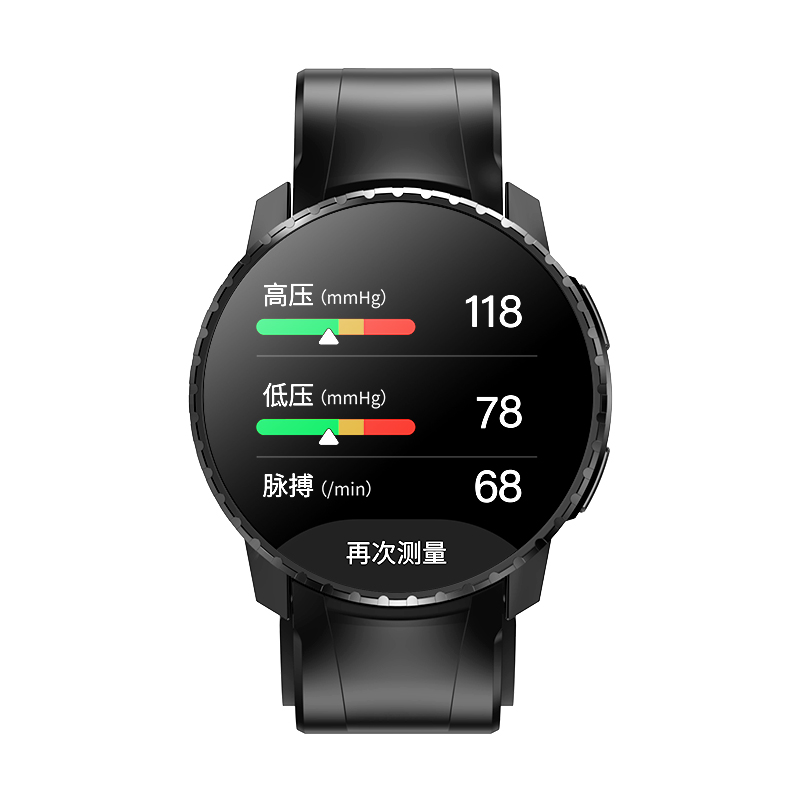
In contrast, a pump-based watch drives air into a sealed bladder so the strap itself compresses the artery. The pump raises bladder pressure until arterial flow is occluded, then releases it under control while the pressure transducer records the amplitude envelope of the arterial pulsation. The specific component set — pump type, valve arrangement, pressure ceiling and deflation rate — is not stated for any model we build; what we can tell you is that the mechanism is a micro air pump with a curved TPU airbag, not an optical estimate. For a deeper analysis of the measurement principle, consult our technical whitepaper on micro-pump vs optical PPG blood pressure watch technology.
2. Cuff Sizing and Wrist Ergonomics (Biomechanical Occlusion)
In traditional upper-arm blood pressure measurement, clinicians select cuff sizes based on mid-arm circumference. Wrist-worn oscillometric devices face an even more demanding biomechanical challenge: the radial artery runs between the flexor carpi radialis tendon and the radius bone, surrounded by tendons that can shield the artery from uniform pressure.
When evaluating device strap engineering, product managers must inspect the following three physical parameters:
- Curved Anatomical Airbag Geometry: Flat, rectangular air bladders buckle when wrapped around a circular wrist, concentrating stress on the lateral margins while leaving the volar surface under-compressed. High-performance models feature pre-curved TPU airbags that match the natural elliptical cross-section of the human wrist.
- Circumference Coverage & Sizing Options: The inflatable bladder has to wrap the wrist circumference closely enough that the artery is actually occluded rather than bypassed. Ask a supplier to state the wrist circumference range each strap length covers, and to say plainly whether that range has been verified on the specific model — we cannot state one: we have not verified a wrist-fit range for any of our models yet, so treat any millimetre band you see published as unconfirmed until you have the approved manual in hand.
- Strap Tensile Rigidity: If the outer watch strap stretches during inflation, pneumatic energy is wasted expanding the exterior rather than compressing the radial artery. Premium watches use reinforced fluororubber or high-tensile cowhide composite straps to direct all pneumatic displacement inward.
What wrist circumference range does each strap length cover?
A bladder that does not wrap the wrist closely enough leaves the artery partly open and biases the reading upward.
Status: — no verified range published
Is that range verified on the exact model, or inherited from a platform?
A platform-level figure does not transfer to a different casing, strap or bladder geometry.
Status:
Does the airbag match the wrist's elliptical cross-section?
A flat bladder buckles at the lateral margins and under-compresses the volar surface.
Status: Curved TPU airbag recorded; geometry not published
Does the outer strap stay rigid while the bladder inflates?
A strap that stretches loses pneumatic energy outward instead of compressing the artery.
Status: — test method not supplied
3. Connectivity Architecture: Standalone 4G Cellular vs BLE Companion
Data architecture determines patient adherence and system reliability. B2B deployments generally fall into two distinct connectivity models:
Option A: Standalone 4G Cellular + GNSS (e.g., VC60, VP21)
In remote monitoring of elderly chronic patients, requiring participants to install mobile apps, configure Bluetooth pairing, and keep a smartphone charged nearby results in significant drop-out rates. Models like the VC60 4G standalone round watch and VP21 cellular rectangular watch carry an ASR1606 cellular baseband and a GPS/BeiDou receiver. We agree the transfer protocol, the encryption scheme and the cloud endpoint policy with you per programme, so we cannot give one fixed answer here — they get settled during integration, and the data-residency terms follow the market you are selling into.
Option B: Bluetooth Low Energy Companion (e.g., VC61, VP20)
For enterprise wellness programs, digital therapeutics, and mobile-first consumer brands, Bluetooth Low Energy (BLE 5.x) provides distinct advantages. Omitting the cellular modem reduces casing thickness and weight dramatically. The VP20 slimline rectangular blood pressure watch is recorded at a 12.6 mm casing depth, with telemetry syncing through a host mobile application. That dimension is a figure taken from the model documentation, not a comparative ranking: no independent measurement of competing devices is held, so the number should be read as this model's own recorded depth.
| Architecture Factor | Standalone 4G Cellular (VC60 / VP21) | Bluetooth Companion (VC61 / VP20) |
|---|---|---|
| Smartphone Requirement | Zero. Operates independently via cellular network. | Requires paired iOS or Android smartphone within range. |
| Battery Capacity | 650 mAh high-capacity Li-Po with NTC | 390 mAh to 500 mAh lightweight Li-Po |
| Enclosure Thickness | 13.8 mm profile | 12.6 mm (VP20) to 13.83 mm (VC61) |
| Weight (Total Assembly) | 86.0 g – 90.9 g | 74.4 g – 89.2 g |
| Ideal B2B Deployment | Senior Care, Remote Patient Monitoring (RPM), Lone Workers | Corporate Wellness, Digital Clinics, Private Label Consumer Brands |
4. Form Factor & User Interface: Circular vs Rectangular Displays
The visual interface dictates information density and target user acceptability. Healthcare buyers should match display architecture to user demographics:
- Circular Dials (1.43" AMOLED, 466×466, 326–332 PPI): Circular enclosures (VC60, VC61) emulate traditional luxury chronometers. They excel in corporate wellness and executive screening where patients prioritize discretion and professional aesthetics over high data density.
- Rectangular Dials (1.95" AMOLED, 410×502, 332 PPI): The rectangular dashboards on VP20 and VP21 measure 410 × 502 pixels, against the round 1.43-inch dial of the VC61. We state the two panel figures rather than a percentage difference between them, because the comparison depends on how you measure a round display against a rectangular one. This allows simultaneous presentation of systolic (SBP), diastolic (DBP), mean arterial pressure (MAP), pulse rate, historical trend graphs, and step-by-step posture guidance on a single screen without scrolling. This layout is strongly preferred for geriatric monitoring and decentralized clinical trials.
5. Clinical Testing Protocol & Environmental Ingress Limits
A successful procurement specification must account for operational boundaries. Devices must be deployed with clear operational protocols:
First, the physiological effect of hydrostatic pressure is significant. Any fluid column develops a pressure difference with height, and a wrist held below heart level is subject to the same relation. This is standard hydrostatics rather than a figure taken from an external clinical guideline, and no guideline citation is claimed here:
The practical consequence is that the further the wrist sits below heart level, the more the reading is biased upward — which is why posture guidance matters more for a wrist device than for an upper-arm cuff. The specific offset for any given posture is not a fixed quantity: it depends on the device and the measurement protocol, and no validated mm-per-centimetre figure is published here. Firmware should provide visual or haptic posture guidance prompting the patient to raise the wrist toward mid-sternum.
Second, buyers must understand water ingress limitations. While LUROGEF blood pressure watches achieve an IP67 ingress rating rated for short-term shallow-water immersion, the physical air pump requires atmospheric venting through acoustic ePTFE membranes. Exposure to hot water, surfactants (soap/detergents), sauna steam, or swimming can degrade pneumatic membrane integrity. OEM documentation must state the immersion limit the rating actually carries, rather than treating the rating as a general water permission.
6. B2B OEM/ODM Procurement Checklist
Before committing to an OEM production run, request the following documentation and firmware engineering capabilities from your manufacturing partner:
- Hardware Verification: Ask any supplier whether a pressure-sensor linearity report and a pump endurance test exist for the specific model, what pressure range each covers, and what the pass criteria were. We hold no such report for our current models, so no linearity or endurance result can be cited, and that is the only answer we can give right now — if you are quoted a range or a cycle count without that paperwork, treat it as unsupported.
- Communication Protocols: The concrete wireless interface, its service definitions and its payload encryption standard — as a written document, not as a verbal assurance. If a supplier cannot produce this, treat the integration scope as unset.
- Software Interface Availability: Whether a documented interface exists at all, who supports it, and what the versioning commitment is. "We can build you one" and "one exists" are different answers — get the second in writing before you design around it.
- Cellular Band Customization: Confirmation of regional LTE-M or NB-IoT frequency bands for target telecommunications providers.
- Firmware Customization: Ability to white-label boot logos, UI themes, warning screens, and custom alert thresholds.