Resources · FAQs
Health Wearable FAQ
Get clear answers about choosing health wearables, planning a connected monitoring programme, evaluating documentation and preparing an OEM or ODM project.
Frequently Asked Questions
All Frequently Asked Questions
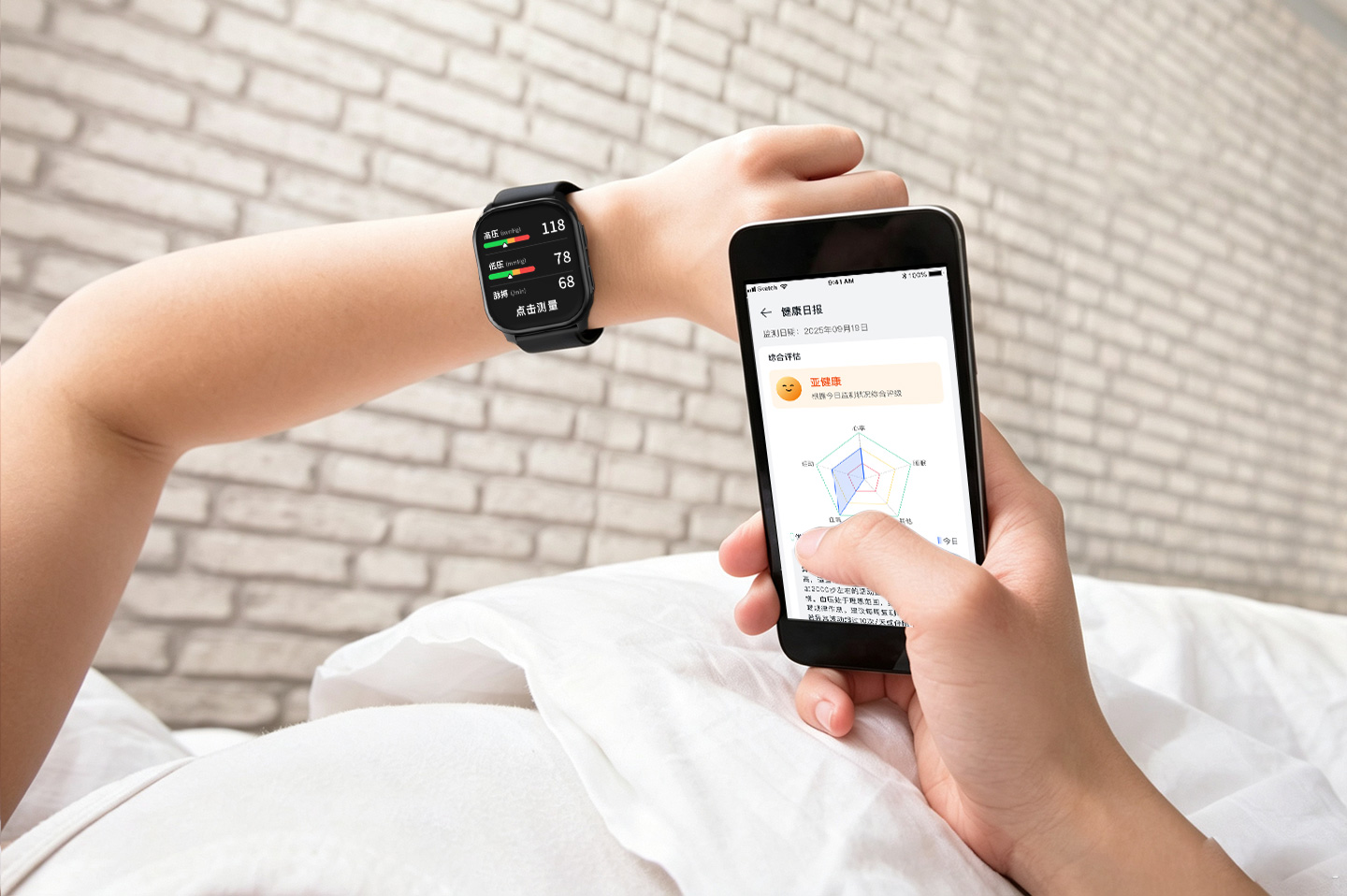
How does an oscillometric watch measure blood pressure, compared with a conventional smartwatch?
An oscillometric watch inflates a wrist airbag and detects pressure changes caused by arterial pulses to calculate blood pressure. An ordinary optical smartwatch measures pulse-related signals with light; that sensing method is different from airbag-based blood-pressure measurement.
What is the difference between the standalone cellular models and the Bluetooth models?
Can these blood pressure watches be worn while swimming or showering?
No. These watches should not be used for swimming or showering, even with an IP67 rating. Avoid hot water, steam and prolonged immersion, which can affect the airbag and pressure-measurement system.
What OEM/ODM customization options are available for a watch programme?
Customization can include case finishes, strap materials, watch faces, startup screens and packaging. Cellular bands, firmware changes and app integration need a model-specific technical review and an agreed OEM/ODM specification.
Why do cuff width and wrist circumference matter for an oscillometric reading?
The airbag must fit closely and apply pressure over the intended area of the wrist. A cuff that is too narrow, too wide or poorly fitted can change the pressure needed to compress the artery and affect the reading; use the strap and airbag specified for the model.
How much does standalone cellular connectivity affect daily battery consumption?
Cellular operation adds power use for network registration, transmissions and location services. Battery life depends on signal strength, upload frequency, positioning settings and measurement frequency, so test the intended configuration rather than estimating runtime from battery capacity alone.
How should a user position their arm during a wrist blood pressure measurement?
Sit quietly, support your arm and keep the wrist at heart level with the airbag positioned as the model's manual shows. Stay still and do not talk during measurement; a wrist held too high or too low can affect the result.
What separates RTOS firmware from a high-level operating system in a medical wearable?
An RTOS schedules firmware tasks with predictable timing and typically uses fewer hardware resources. A high-level operating system supports a broader app environment but generally needs more memory and power; either approach still requires validation of the measurement and reporting functions.
Why does an optical PPG signal struggle with calibration drift over time?
Optical estimates depend on the relationship between pulse signals and blood pressure. Changes in vascular tone, temperature, sensor contact or the user's physiology can alter that relationship, so an earlier calibration may no longer represent current conditions.
Can optical PPG and micro-pump oscillometry be combined in one device?
Yes. Optical sensing can support pulse-related monitoring while a pump and airbag perform intermittent oscillometric blood-pressure measurements. The two measurement paths need separate signal processing and validation; adding both does not automatically improve blood-pressure accuracy.
How does wrist movement affect oscillometric waveform extraction?
Wrist movement changes airbag pressure and can introduce signals that resemble arterial pulses. Keep the wrist supported and still; if the device flags motion or an unsuccessful reading, reposition and repeat according to its instructions.
What sensors does the smart ring platform actually include?
The CARE2 includes a PPG optical sensor, a 3-axis accelerometer and a temperature sensing module, with Bluetooth 5.1 connectivity. These support pulse-related, activity and temperature trends.
Can the ring be worn while swimming, in a hot spring or in the shower?
Use the ring for ordinary daily exposure such as hand washing, sweat and brief rain. Swimming, hot springs, showering and prolonged immersion are outside the stated use limits; remove it before those activities.
Does the ring measure blood pressure, ECG or blood glucose?
What OEM/ODM customisation is available for a private-label ring programme?
Options include ring surface finishes and engraving, charging-dock and accessory branding, packaging and sizing-kit arrangements. App changes and data integration require a technical scope review; confirm available sizes, MOQ and delivery terms in the quotation.
Should a private-label ring programme start with the material or with the sensor set?
Start with the measurements and user experience your brand needs, then select the sensor set and physical design. A premium material cannot provide a measurement capability that the hardware does not contain.
How do we choose a sensor set that matches our programme’s data promise?
List every metric you intend to offer and map it to a sensor, processing method and supporting evidence. The CARE2's optical, motion and temperature sensors support wellness trends; blood-pressure, ECG and glucose requirements need different measurement hardware.
How should we plan the sizing step so it does not damage our return rate?
Send a physical sizing kit before collecting the final ring-size order. Ask users to check fit through normal daily temperature changes and confirm the chosen size before shipment; a printed size chart alone can lead to avoidable returns.
What documentation should we request before committing to a ring production run?
Request the final model specification, available sizes, finish samples, app compatibility, use instructions, warranty terms and applicable test or conformity records. Also agree on the production sample, packaging artwork and acceptance criteria before the bulk run.
Why can’t a ring simply reuse the optical design of a wrist wearable?
Finger and wrist tissue, geometry, contact pressure and light paths differ. A ring needs an optical layout and processing approach suited to finger placement; reusing a wrist design without validation can reduce signal quality.
What is the 3-axis accelerometer doing beyond counting steps?
It records movement in three axes and helps identify motion that can interfere with optical measurements. Firmware can use it for activity detection, movement records and assessing whether a pulse sample was captured during a sufficiently still period.
What does the independent temperature module measure, and what does it not measure?
It measures temperature at the skin-contact point on the finger. The useful output is a trend relative to the user's baseline; it is not a direct measurement of core body temperature.
Where does a ring’s optical signal chain stop being reliable?
Loose fit, finger movement, poor skin contact, low perfusion and changing ambient conditions can weaken or distort an optical signal. Readings should be assessed with the device's quality checks rather than treated as equally reliable in every situation.
Can the ring’s output be described as a screening or diagnostic result?
The CARE2 is presented as a wellness-trend device. Screening or diagnostic claims require evidence and market authorization for the specific intended use; the presence of optical, motion and temperature sensors alone does not establish that claim.
Is the glucose sensor inside the watch or the ring?
No. The S10 uses a separate, single-use adhesive sensor applied to the upper arm. A compatible watch or phone app displays the sensor's glucose readings; it does not measure glucose from the wrist or finger.
Which parts make up the system, and how does data move between them?
The system consists of the upper-arm sensor and a compatible display device or phone app. The sensor generates readings and sends them wirelessly to the configured receiver; any onward transfer to another platform requires a separately confirmed integration.
What are the S10 CGM wear period, reading interval and accuracy specifications?
The published S10 specifications are a 15-day sensor wear period, readings every 3 minutes and MARD of 8.32%. MARD is an average comparison with reference measurements, not a guarantee of the error of every reading; use the corresponding validation documentation when describing accuracy.
Is this system registered or approved for sale in a given market?
The product documentation lists Chinese registrations Guo Xie Zhu Zhun 20253071982 and Yue Xie Zhu Zhun 20242071765. Sale in another territory requires checking the exact model, intended use and applicable local registration; Chinese registration does not automatically authorize sale elsewhere.
What can we customise, and what should we request in writing before we commit?
Branding, packaging and software requirements can be reviewed for the selected configuration. Before committing, agree on sensor and receiver compatibility, app ownership, integration scope, kit contents, documentation, MOQ and lead time in writing.
Should a programme choose the sensor first or the data workflow first?
Define the user group, intended use, reading destination and response workflow first. Then select a sensor and receiver combination that supports that workflow and the required documentation for the target market.
How do we compare two CGM systems when both specification sheets say the same thing?
Compare the validation study population, reference method, error distribution, wear-period performance, reading interval and communication reliability. Also assess app compatibility, training, replacement procedures and registration scope; matching headline specifications do not establish equivalent performance.
Who is responsible when a reading fails to appear on the display device?
Responsibility should follow the failed part of the chain: sensor operation, pairing and wireless transfer, receiver or app processing, or onward platform integration. Assign an owner for each stage and record logs and troubleshooting steps before deployment.
What documentation should we have in hand before we list the system in our market?
Obtain the model's registration or authorization documents for the territory, intended-use statement, instructions, labels and performance evidence. Include receiver compatibility, storage and transport requirements, supplier details and the complaint or replacement process.
What are the warning signs that a connected monitoring programme is drifting?
Watch for rising pairing failures, missing readings, premature sensor replacements, user dropouts and delayed follow-up. Track these against agreed targets so the team can identify whether the problem lies in the sensor, communications, training or service workflow.
Why does a CGM system need a sensor in contact with the body instead of reading optically?
This system measures glucose through a sensing element in contact with interstitial fluid. Its measurement method relies on a local chemical reaction; a watch or ring's optical pulse sensor does not replace that sensing element.
How does an enzyme-based sensing element turn a chemical reaction into a readable signal?
Glucose interacts with the enzyme-based sensing layer and produces an electrical response related to glucose concentration. Electronics and processing convert that response into a displayed value using the sensor's calibration and signal-processing method.
What is happening to the sensor across a wear period, and why is the wear period finite?
The sensing chemistry, tissue interface and adhesive change during use, which can affect signal quality and attachment. The S10 has a specified 15-day wear period; replace the single-use sensor as instructed rather than extending its use beyond that period.
How does the reading get from the sensor to the screen, and what happens if that link breaks?
The sensor sends processed readings wirelessly to a compatible receiver or app. If the link breaks, the screen may stop updating; check pairing, distance, receiver power and timestamps, and follow the instructions for reconnecting and handling missing readings.
Is the number on the screen the same thing as the raw sensor signal?
No. The raw signal is an electrical response from the sensing element. The displayed glucose value is produced after calibration and processing, and its timestamp matters when checking whether it represents a current reading.
Who is responsible for certification and market registration when we sell under our own brand?
The brand owner or local market operator must establish the registration and compliance route for the product sold in that territory. LUROGEF supports the agreed manufacturer documentation; the contract should identify who files applications, approves labels and maintains each record.
What can we actually change to make the product ours?
Depending on the platform, you can review case or ring finishes, straps, engraving, watch faces, startup screens, packaging and selected software changes. New hardware or measurement functions require engineering review and a defined development scope.
What do you need from us before you can scope anything?
Send the target market, product type, intended use, required features, estimated quantity, launch timing and customization needs. Include any app, data integration, certification or packaging requirements so the scope can be reviewed together.
What should a brand write down before it goes looking at hardware?
Write down the users, intended use, target territories, required measurements, price position, quantities and launch goals. Add branding, packaging, app ownership and support responsibilities so suppliers can quote against the same brief.
Do we need our own certification to sell this under our brand?
That depends on the territory, device classification, model and how the brand owner is identified on the label. Confirm with the local regulatory route whether manufacturer records can support the branded version or whether a separate filing is needed.
Who designs the packaging and controls what is printed on the label?
Packaging design can be assigned to your team or included in the project scope. The brand owner should approve final artwork, and the party responsible for market compliance should verify the model, claims, required symbols and local-language instructions before printing.
What are the most common ways a private-label wearable programme goes wrong?
Common problems include changing requirements after sample approval, unclear app ownership, incomplete market documentation, late packaging decisions and missing support responsibilities. A signed specification, approved sample and written handover plan reduce these risks.
What does a distributor actually take on when it carries a wearable line?
A distributor takes on local listing, stock planning, customer training, returns and first-line support, together with any applicable importer duties. Agree which technical problems the supplier handles and how replacements, warranty claims and app issues are escalated.
Which technical documents should a supplier be able to provide?
Request the model specification, instructions, applicable test reports and conformity or registration records, together with battery and shipping information. For connected products, also request app compatibility and the documentation available for the agreed data connection.
How do we judge whether a supplier’s claims are safe to repeat?
Match each claim to the exact model, intended use and supporting report or registration record. Check the document's holder, date and scope; a factory certificate or another model's test report is not sufficient evidence for every product claim.
Can we legally list this product in our territory, and who proves it?
You can list it when the exact model and intended use satisfy the territory's applicable requirements. The local brand owner, importer or authorized representative should verify the route using manufacturer documentation before accepting orders.
How does a measurement actually get from the device into our workflow?
A supported device sends readings through its configured cellular or Bluetooth/app connection. Transfer into your own workflow requires confirmation of the receiving platform, interface, data fields and authorization process; agree and test that path before deployment.
Who is responsible for what once the service is live?
Assign device support and firmware maintenance to the agreed supplier team, and service operations, user onboarding and follow-up to the programme operator. Also name owners for app hosting, access control, incident handling and integrations so faults reach the right team.
On what basis may we collect and share someone’s measurement data?
Use an appropriate legal basis and a clear authorization process for the deployment's territory. Explain which measurements are collected, who receives them, why they are shared and how users can withdraw authorization; restrict access to the agreed recipients.
Can we start with a small deployment and scale later?
Yes. Start with a defined pilot, review measurement completion, connection reliability, user onboarding and support workload, then expand when the agreed targets are met. Confirm supply and replacement arrangements before increasing device numbers.
What should we not say about this once it is deployed?
Describe only the selected device's documented functions and the service you actually provide. Do not imply that a display device measures glucose, promise guaranteed clinical outcomes or extend water-use limits beyond the model's instructions.
Should we choose the device first or the workflow first?
Start with the workflow: who measures, where the reading goes, who reviews it and what happens when data is missing. Then select hardware that supports the users, communication conditions and intended measurement requirements.
Cellular or Bluetooth — how do we decide?
Choose cellular when users need reporting without a paired phone and the deployment has suitable network coverage. Choose Bluetooth when users can reliably use a compatible phone and app; compare onboarding, power use and ongoing connectivity costs.
How much user training does a measurement protocol really need?
Train users on fit, measurement posture, keeping still, pairing, charging and recognizing an unsuccessful reading. Include a supervised practice measurement and a short illustrated guide; the training needed depends on the model and user group.
Which documents should we obtain before committing?
Obtain the device specification and instructions, market documentation, data-path requirements and app compatibility. Agree on user authorization, support ownership, replacement procedures and pilot acceptance criteria before purchasing the deployment configuration.
How many devices should a pilot use?
Use enough devices to cover the important user groups, connectivity conditions and support scenarios. There is no universal count; define what the pilot must test and select a sample that can expose the main operational problems.
How do we know the data flow will hold up?
Test the complete path from measurement to the receiving screen or platform, including weak signal, lost pairing, restart and reconnection. Track timestamps, missing readings and delivery delays against agreed criteria rather than checking only whether one reading arrives.
What does the authorization step actually have to cover?
It should explain the measurements collected, their purpose, recipients, access permissions and retention arrangements. Include how authorization is recorded, how it can be withdrawn and what happens to previously shared data, consistent with the applicable legal requirements.
What counts as a successful pilot?
A successful pilot meets predefined operational targets for onboarding, measurement completion, delivery reliability and support response. Users and staff should be able to perform their tasks consistently, with clear procedures for missing data and faulty devices.
What will this pilot not prove?
An operational pilot does not by itself establish diagnostic accuracy, treatment benefit or authorization to sell in a new market. Those questions require the appropriate performance evidence, study design and regulatory process.
What does the OEM/ODM service include?
OEM/ODM is a development and manufacturing service built around your product brief. You can start from an existing wearable platform or scope engineering changes; the product catalogue provides model specifications for the starting options.
What exactly do you design and develop, and what is outsourced?
Capabilities include industrial and structural design, hardware development, firmware, app work, assembly and production testing. Complete-device production combines in-house work with outsourced processing where needed; the project scope should identify the actual suppliers and manufacturing steps.
Which requirements need a separate technical review?
Standard OEM/ODM scope does not automatically include a new measurement capability, every third-party integration or registration in every country. Any additional hardware, interface or regulatory work needs technical review and explicit inclusion in the specification and quotation.
What may we say about the finished product once it is ours?
Use claims supported by the finished model's approved specification, instructions and market documentation. Branding changes do not expand the device's functions or the territory covered by its registration; review label and marketing copy before launch.
What has to be written down before design starts?
Document the users, intended use, functions, target markets, materials, measurements, connectivity, packaging and acceptance criteria. Also agree on budget, quantities, milestones, ownership and the procedure for approving changes.
Why does the hardware and firmware platform decision matter so much?
The platform determines available sensors, communication options, processing resources, power use and update paths. Changing it later can require a new PCB, firmware, tooling and testing, so confirm the essential functions before development starts.
How far can the app and interface actually be customized?
Customization may cover interface branding, watch faces, workflow screens and selected firmware or app functions. Supported changes depend on the platform and software rights; define each screen, data field and integration requirement before agreeing scope.
Where does the project end, and is everything in-house?
The project ends at the agreed delivery and handover milestone, with any warranty or maintenance continuing under its own terms. Engineering and complete-device manufacturing include in-house work and outsourced processing; confirm the exact production and service responsibilities in the contract.
What technical documentation must we be able to produce?
Maintain the finished-product specification, design and change records, relevant test evidence, instructions, labels and market documentation. The required file depends on the product and territory; agree who prepares, approves and retains each document.
Whose job is it to place the product on a market?
The party placing the product on the market must arrange the applicable local compliance and registration duties. Manufacturer support documents form part of that process; the contract should name the brand owner, importer or representative responsible for the filing.
Who controls the label, the claims and the changes to them?
Assign final label and marketing approval to the brand's authorized team, with regulatory review for the target market. Changes to measurements, materials, labeling or intended use should go through a documented review before release.
Who is LUROGEF, and what does the company do?
LUROGEF is a health technology brand focused on blood-pressure wearables, smart rings and connected glucose monitoring. Founded in 2015, the business has developed from chip R&D into wearable engineering, complete-device manufacturing and OEM/ODM services.
How big is the company, and how many patents does it hold?
Company materials report a 3,000 m² facility, more than 50 employees and annual capacity of 1 million units. They also report 6 invention patents, 50 utility model patents and 19 software copyrights.
What certifications and licences do you hold — and what do they actually cover?
The published portfolio includes a medical-device production licence, ISO 13485:2016 certification, an invention patent, and RED and RoHS conformity records for XC-VC61 and XC-VP20. Each document covers its stated holder, activity, model or standard; check that scope for your order. View our certificate portfolio.
Does holding a production licence and an ISO 13485 certificate mean your products are approved?
No. A production licence covers authorized manufacturing activities, and ISO 13485 concerns the quality-management system. Product registration or authorization must be checked separately for the exact model, intended use and territory.
What are the intended-use limits of these devices?
Who do you work with, and can you show me a customer reference or a case study?
Published news describes exhibitions and connected-health projects, including the Longgang family-doctor platform and Ant Health's hardware ecosystem. For a procurement reference, request a relevant case summary and permission to contact the customer; a displayed logo alone does not establish the scope of a project. Browse our company news for published project updates.
What is the difference between a production licence and an ISO 13485 certificate?
A production licence is a legal authorization for the stated manufacturing activities in the issuing jurisdiction. ISO 13485 certification evaluates a defined quality-management-system scope; it does not replace a production licence or model-specific registration.
The certificate says “medical device” — doesn’t that mean the measurements are accurate?
The word “medical device” on a factory or quality certificate does not quantify measurement accuracy. Request model-specific performance or clinical evaluation evidence, including the reference method, study conditions and applicable intended use.
What exactly should I ask a supplier for, in writing?
Ask for the legal manufacturer name, exact model, specification, instructions, relevant registration or conformity records and performance evidence. Add commercial terms, warranty, support ownership and any integration deliverables required for your project.
How do I check that a certificate belongs to the company I am dealing with?
Compare the legal name and address on the document with your supplier's company records. Check the certificate number, issuer, validity dates and scope, and verify it through the issuer or regulator's official records where available.
What actually happens between “we want this product” and a shipped unit?
The usual sequence is requirements, platform selection, development or customization, prototype review, testing, sample approval and bulk production. Packaging, market documentation and handover planning should progress alongside the hardware work.
Why can’t water resistance, wear duration or a different sensor be added later?
Those requirements affect enclosure seals, materials, power, electronics and test plans. A different sensor or higher water-use target can require redesigned hardware and tooling; include essential requirements in the initial brief so changes can be evaluated early.
Where does the factory’s ISO certificate fit in my project — is my product covered by it?
The ISO certificate applies to the named organization's quality system within its stated scope. Your project must use relevant covered processes, while the finished product's compliance and performance still need their own documentation.
Which steps are actually done in-house, and which are outsourced?
The company describes in-house engineering and complete-device manufacturing, with some outsourced processing. Ask for the manufacturing flow for your model, identifying assembly, testing, packing and any externally supplied or processed parts.