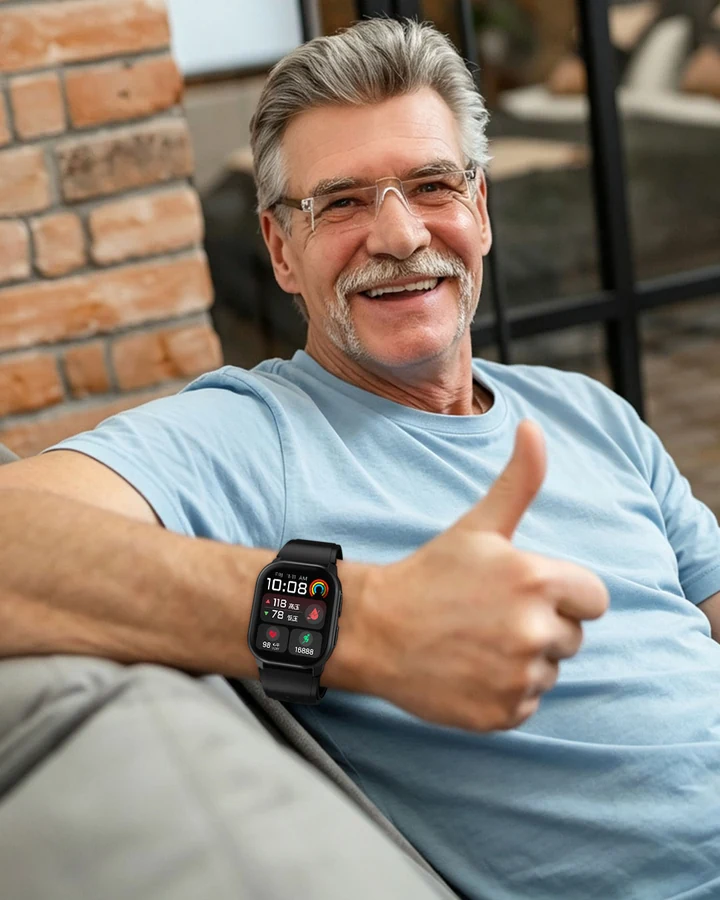
As the global population ages, health technology companies, medical device distributors, and senior care solution providers are exploring new ways to support older adults in their daily lives.
According to the World Health Organization (WHO), one in six people worldwide will be aged 60 or older by 2030.
For businesses serving this population, wearable health monitoring devices represent an opportunity to develop products that combine everyday health measurement, convenient communication, and connected care experiences.
Among these products, 4G blood pressure smartwatches offer a particularly interesting combination of dedicated wrist-based measurement hardware, cellular connectivity, and selected safety features.
However, choosing a device for senior care requires more than comparing specifications.
What functions do older users actually need? How does a 4G blood pressure watch differ from a standard smartwatch? What should distributors and OEM/ODM buyers verify before launching a product?
This guide explores these questions from a B2B perspective, with practical recommendations for health wearable brands, senior care businesses, and connected health service providers.
1. What Are Wearable Health Monitoring Devices for Seniors?
Wearable health monitoring devices are electronic products worn on the body to collect supported health measurements, activity information, or other physiological data.
For older adults, these products can provide convenient access to certain health measurements and help support everyday routines.
Common device categories include:
- Blood pressure smartwatches: Wrist-worn devices with dedicated pressure-measurement functions.
- Heart rate monitor watches: Devices that collect pulse-related information through optical sensors.
- Wearable activity trackers: Products that record movement, activity patterns, and selected wellness indicators.
- Connected glucose monitoring devices: Dedicated glucose sensors that transmit readings to compatible displays and applications.
- Connected safety wearables: Devices with selected calling, positioning, or assistance functions.
These product categories serve different purposes. Not every health wearable is a medical device, and not every recorded wellness metric is suitable for clinical decisions.
For B2B buyers, product selection should begin with the specific measurement or service the customer needs.
2. Why Senior Care Businesses Are Exploring Health Monitoring Watches
Traditional home health monitoring may require several separate devices, written measurement records, and manual communication with family members or healthcare professionals.
Connected wearable technology creates opportunities to make certain parts of this experience more convenient.
Convenient Access to Health Information
A health monitoring watch gives users access to supported measurements directly on a familiar wrist-worn device.
When paired with a compatible application, selected devices may also provide historical records and trends.
For senior-focused products, a clear display and straightforward measurement process can be more important than offering a large number of advanced features.
Communication Beyond the Home
Older adults may not always carry a smartphone, particularly during short walks, household activities, or daily outings.
A standalone 4G watch can support cellular communication without requiring a continuously paired phone, provided network coverage, SIM configuration, and the necessary services are available.
This creates opportunities for senior care brands developing connected communication products.
Support for Daily Routines
Selected wearables offer medication reminders, activity prompts, and other scheduled notifications.
These features can support everyday routines, although they do not confirm that medication has been taken or replace professional care.
Connected Family Experiences
Where the product and application support it, health information may be shared with authorized relatives or caregivers.
The important requirement is permission-based access. A brand should establish who can view which records, how consent is managed, and whether the user can withdraw access.
3. Why Consider a 4G Blood Pressure Smartwatch for Senior Care?
A blood pressure watch combines a wrist-worn form factor with a mechanism designed for measuring blood pressure.
Some products estimate blood pressure using optical signals and software, while others incorporate dedicated inflatable components.
These approaches are not equivalent.
Dedicated Oscillometric Measurement
Selected blood pressure smartwatches use a miniature air pump and inflatable airbag built into the wrist strap.
During a measurement, the airbag applies pressure around the wrist. The device analyzes pressure oscillations to calculate the displayed systolic and diastolic readings.
A dedicated measurement mechanism is an important technical distinction, but it does not automatically establish accuracy or suitability for medical use.
Buyers must review model-specific validation evidence and the intended measurement procedure.
Important Accuracy Considerations
The American Heart Association recommends a validated upper-arm cuff-style monitor for routine home blood pressure monitoring. Wrist devices are generally less reliable and require careful positioning.
Read: American Heart Association — Home Blood Pressure Monitoring.
For any wrist-based blood pressure watch, the user typically needs to remain still and position the wrist correctly at heart level.
A wearable's convenience should therefore be evaluated alongside its measurement limitations.
4G Connectivity for Independent Communication
Bluetooth smartwatches normally rely on a paired smartphone for connected services.
A standalone 4G smartwatch can provide supported cellular functions through its own communication hardware.
This can be useful in senior care products designed for users who do not consistently manage smartphone pairing.
However, having 4G hardware does not automatically mean that readings can be sent to a hospital, caregiver dashboard, or remote patient monitoring system.
These functions depend on the selected software, network service, data interfaces, and application configuration.
4. Essential Features to Consider in a Senior Health Monitoring Watch
Senior-focused products should prioritize functions that match actual user needs.
| Feature | Potential Benefit | What B2B Buyers Should Verify |
|---|---|---|
| Blood pressure measurement | Convenient access to supported blood pressure readings | Measurement method, validation, intended use |
| Heart rate monitoring | Pulse-related information for everyday reference | Supported sensors and documented performance |
| 4G calling | Communication without a paired smartphone | Cellular bands, SIM support, network compatibility |
| GPS / BeiDou positioning | Location information for authorized users | Coverage, accuracy conditions, permissions |
| SOS button | Initiates a configured assistance workflow | Contact setup, network dependence, response process |
| Medication reminders | Supports scheduled daily routines | Available models and reminder configuration |
| Large display | Easier access to information | Text size, contrast, usability |
| Battery capacity | Supports the intended usage routine | Real-world performance under the target configuration |
| Connected application | Organizes supported records | Available data fields, sharing and integration |
A product with more features is not necessarily better.
For example, a senior care programme that mainly requires communication may value reliable 4G connectivity and a simple interface more than complex fitness functions.
Meanwhile, a project centered on blood pressure measurements must prioritize appropriate measurement equipment, validation, and user training.
5. 4G vs Bluetooth Health Monitoring Watches: Which Is Better for Seniors?
Connectivity is one of the most important decisions for OEM/ODM buyers.
Both options have practical advantages.
Bluetooth Blood Pressure Smartwatch
A Bluetooth model communicates with a compatible smartphone application.
Potential advantages:
- Suitable for users who regularly use smartphones
- Supports a companion-app experience
- Avoids an independent cellular service requirement
- May allow a simpler connected-device configuration
Considerations:
- The user may need to maintain smartphone pairing
- Some functions depend on the phone and its network access
- Data synchronization requires a working connection
4G Blood Pressure Smartwatch
A standalone cellular model includes dedicated mobile communication hardware.
Potential advantages:
- Selected functions can operate without a paired smartphone
- Calling and location features can support connected family scenarios
- Suitable for exploring phone-independent communication workflows
Considerations:
- Cellular coverage and carrier compatibility must be checked
- SIM and data-service costs may apply
- Battery performance depends on network conditions and usage
- Remote data access requires confirmed software and integration support
B2B Recommendation
A Bluetooth device may be appropriate for a health brand selling to smartphone-comfortable users.
A 4G model may be more relevant for senior-focused programmes that prioritize phone-independent communication.
For a formal remote patient monitoring programme, neither option should be selected before confirming the complete measurement, transmission, data review, and support process.
6. LUROGEF 4G Blood Pressure Watch Platforms for Senior-Focused Products
LUROGEF develops and manufactures health wearable products for OEM, private-label, and ODM projects.
Its blood pressure smartwatch portfolio includes dedicated oscillometric measurement platforms with both Bluetooth and 4G configurations.
For senior and family health applications, two platforms are particularly relevant.
LUROGEF VC60: Round 4G Blood Pressure Watch
The VC60 Blood Pressure Watch combines a round smartwatch design with dedicated wrist blood pressure measurement hardware.
Documented product features:
- 1.43-inch AMOLED round display
- Micro air pump and TPU airbag measurement system
- 4G cellular connectivity
- GPS / BeiDou positioning
- SOS functionality
- Electronic fence functionality
- 650 mAh battery
The VC60 may be considered by brands developing a traditional round-watch product with connected communication and safety-oriented features.
Its compact watch-style appearance may also be suitable for businesses that prefer a conventional wearable design.
LUROGEF VP21: Rectangular 4G Blood Pressure Watch
The VP21 Blood Pressure Watch offers a different design approach with a larger rectangular display.
Documented product features:
- 1.95-inch AMOLED rectangular display
- Micro air pump and TPU airbag measurement system
- Standalone 4G connectivity
- GPS / BeiDou positioning
- SOS and cellular communication functions
- 650 mAh battery
The larger display may be useful for applications where readability and direct on-device interaction are priorities.
VC60 vs VP21: Product Comparison
| Specification | VC60 | VP21 |
|---|---|---|
| Display shape | Round | Rectangular |
| Display size | 1.43-inch AMOLED | 1.95-inch AMOLED |
| Blood pressure hardware | Air pump + TPU airbag | Air pump + TPU airbag |
| Cellular connectivity | 4G | 4G |
| GPS / BeiDou | Supported | Supported |
| SOS | Supported | Supported |
| Battery capacity | 650 mAh | 650 mAh |
| Potential positioning | Traditional watch-style design | Larger-screen connected health watch |
Both platforms can serve as starting points for OEM/ODM discussions.
Final product suitability depends on the actual user group, usability testing, available software configuration, measurement documentation, and applicable market requirements.
Explore the complete range: LUROGEF Blood Pressure Watch Manufacturer
7. Four Business Applications for Senior Health Wearable Devices
Different buyers approach senior health wearables with different commercial objectives.
Understanding the intended application helps determine which product platform and customization scope are appropriate.
Application 1: Senior Care Product Brands
A company developing a senior-focused consumer product line may want a wearable combining selected health measurement and communication functions.
Key product considerations include:
- User-friendly design
- Display readability
- Comfortable straps
- Product branding
- Charging and maintenance
- Clear user instructions
An existing 4G blood pressure watch platform may offer a starting point for the project, subject to appropriate validation and market requirements.
Application 2: Home Health Service Providers
Home health businesses may explore connected measurement devices for defined at-home monitoring workflows.
The device alone is not a complete remote monitoring service.
The project also needs appropriate measurement procedures, authorized access to information, data handling processes, and clearly defined responsibilities for clinical review where applicable.
For programmes involving clinical blood pressure decisions, validated upper-arm monitors may be the preferred solution.
Application 3: Senior Care Technology Distributors
Regional distributors may want to expand their catalogues with connected health and communication devices.
Their evaluation should cover:
- Product-market fit
- Regional cellular compatibility
- Language and packaging requirements
- Model-specific regulatory documentation
- Local warranty and technical support
- Replacement parts and long-term software support
Distribution agreements should also specify which company is responsible for product authorization, labeling, and post-market obligations.
Application 4: Family Health Technology Platforms
Technology providers building family-connected applications may evaluate smartwatches with communication, location, and selected health information functions.
For these projects, the software experience matters as much as the physical device.
Buyers should confirm available interfaces, user permissions, data access, and integration feasibility before committing to development.
Related application: Senior & Family Health Wearable Solutions
8. OEM/ODM Customization for Senior Health Monitoring Watches
A successful private-label product needs more than a logo printed on an existing smartwatch.
Different markets and users may require changes to industrial design, software, and overall product presentation.
Depending on the selected platform and development scope, LUROGEF can evaluate customization across several areas.
Product Appearance and Branding
Potential requirements include:
- Watch case finishes
- Strap materials and colors
- Brand logos
- Packaging and accessories
- Product documentation
User Interface Customization
A senior-focused experience may require:
- Larger text
- Simplified navigation
- Clearer function labels
- Local-language interfaces
- Branded watch faces or startup screens
Available changes must be evaluated against the selected device's firmware and software architecture.
Connectivity and Application Requirements
For connected product projects, buyers should specify:
- Target countries and cellular networks
- Required device and application functions
- Measurement records to be accessed
- Authorized user roles
- Data retention and privacy requirements
- Integration with existing systems, if needed
SDK, API, cloud connectivity, and third-party platform integration should be confirmed individually rather than assumed.
OEM vs ODM Manufacturing
OEM or private-label manufacturing generally begins with an existing hardware platform and an agreed branding or configuration scope.
ODM development may involve deeper changes to the industrial design, hardware, firmware, or software.
The appropriate route depends on budget, customization requirements, engineering feasibility, and the intended product launch.
Learn more: LUROGEF Health Wearable OEM & ODM Services
9. What Should B2B Buyers Check Before Ordering Senior Health Monitoring Devices?
For products associated with health measurements, supplier evaluation should go beyond appearance, quotation, and delivery time.
Consider the following procurement checklist.
Measurement Performance
Request the technical description of each measurement function and the available validation evidence.
Confirm whether the device directly measures a parameter, estimates it, or displays information received from another sensor.
Regulatory Requirements
Confirm the regulatory classification, intended use, applicable standards, and authorization requirements for the destination market.
For example, the U.S. FDA has warned against unauthorized devices claiming to measure blood pressure, including certain wearable products.
Read: FDA Safety Communication on Unauthorized Blood Pressure Devices.
Manufacturing quality-system certification does not automatically mean that a particular product is authorized for medical use in every market.
Senior User Experience
Test samples with representative intended users, where appropriate.
Evaluate display readability, strap comfort, button accessibility, charging requirements, measurement instructions, and whether important functions can be completed without assistance.
Cellular Compatibility
For 4G models, request supported frequency bands and check the proposed configuration against local carriers.
Do not assume that a device supporting 4G in one country will work on every network.
Data Privacy and Sharing
Determine what information the device collects, where data is stored, who can access it, and how access can be withdrawn.
Applicable privacy requirements depend on the deployment location, service model, and the organizations processing the data.
Manufacturing and Commercial Terms
Clarify:
- Minimum order quantity
- Sample availability
- Customization costs
- Production lead times
- Quality inspection procedures
- Packaging requirements
- Warranty and replacement arrangements
- Software maintenance responsibilities
A written product specification and acceptance criteria should be agreed upon before bulk production.
10. How to Start a Senior Health Wearable OEM/ODM Project
Before contacting a health wearable manufacturer, prepare a short project brief.
A useful brief should answer six questions.
1. Who will use the product?
Identify the intended senior user group, including relevant usability and accessibility requirements.
2. What is the main purpose?
Is the product primarily intended for communication, wellness tracking, blood pressure measurement, or a defined remote monitoring programme?
3. Where will it be sold or deployed?
Specify target countries and intended sales or service channels.
4. Which features are essential?
Separate essential requirements from optional functions, such as positioning, SOS, reminders, and application integration.
5. What customization is required?
Describe branding, materials, interfaces, software, language, and packaging requirements.
6. What is the expected commercial scope?
Share the estimated order quantity, target schedule, and any known procurement requirements.
A clear project brief helps the manufacturer identify an appropriate starting platform, explain the available customization scope, and prepare a more relevant technical and commercial proposal.
Frequently Asked Questions
What is the best wearable health monitoring device for seniors?
The best device depends on the intended use. A communication-focused product may prioritize standalone cellular functionality and readability, while a clinical blood pressure monitoring programme requires appropriately validated measurement equipment. No single wearable is best for every senior care application.
Can a 4G blood pressure watch work without a smartphone?
Selected 4G models can support cellular functions without a continuously paired smartphone. However, network coverage, SIM configuration, application services, and data delivery requirements must be confirmed for the actual deployment.
Can a blood pressure smartwatch replace a medical blood pressure monitor?
Not automatically. For routine clinical home blood pressure monitoring, the American Heart Association generally recommends a validated upper-arm cuff monitor. A wrist-worn device must be assessed for its own measurement performance, authorization status, and intended use.
Can family members view health information remotely?
This depends on the selected device, compatible application, and configured sharing functions. Remote access must be supported by the actual system and controlled through appropriate user authorization.
Are SOS and GPS features available on every health smartwatch?
No. These capabilities vary by model. LUROGEF's VC60 and VP21 have documented 4G, positioning, and SOS functions, but service availability depends on the selected configuration and network conditions. An SOS feature does not guarantee an emergency response.
Can I order private-label 4G blood pressure watches from LUROGEF?
LUROGEF supports OEM, private-label, platform customization, and ODM project discussions. Available modifications, sample options, order quantities, and delivery terms are confirmed according to the selected hardware and project requirements.
Conclusion: Build Senior Health Wearable Products Around Real User Needs
The growing interest in connected senior care creates opportunities for health technology brands, distributors, and digital health businesses.
However, successful wearable products need to solve clearly defined problems.
A 4G blood pressure watch can combine dedicated wrist measurement hardware with selected cellular communication, location, and safety features.
For senior-focused projects, the most important considerations are usability, suitable measurement performance, reliable connectivity, appropriate regulatory documentation, and a software experience that matches the intended service.
Choosing an experienced manufacturing partner can help businesses evaluate these requirements and develop a realistic product roadmap.
Develop Your Senior Health Wearable Product With LUROGEF
Are you planning to launch a private-label senior health monitoring watch or develop a connected wearable product for your market?
LUROGEF provides OEM/ODM development and manufacturing support for health wearable brands, distributors, and technology companies.
Our existing platforms include oscillometric blood pressure watches, wellness smart rings, and connected glucose monitoring products.
Whether you need an existing hardware platform or a more customized development programme, we can discuss your product requirements and help identify the next evaluation steps.
Contact LUROGEF for OEM/ODM Project Consultation
Explore our solutions: