The health wearable market offers growing opportunities for brands, distributors, and digital health companies. However, choosing the right product is not simply about following consumer trends or adding more sensors.
For businesses planning to introduce a new health wearable, two product categories deserve particular attention: smart rings and blood pressure smartwatches.
Both offer connected health monitoring experiences, but they serve different purposes. A smart ring is typically designed for discreet wellness tracking, while a blood pressure watch can provide dedicated wrist-based blood pressure measurements when equipped with the appropriate measurement hardware.
Understanding these differences is essential for businesses evaluating OEM/ODM manufacturing, private-label development, or expansion into the health technology market.
In this guide, we compare smart rings and blood pressure watches from a B2B perspective, including their technology, applications, customization possibilities, and product selection considerations.
1. Smart Ring vs Blood Pressure Watch: Key Differences
The short answer: Choose a smart ring when your product strategy centers on comfortable daily wear, sleep tracking, activity monitoring, and wellness insights. Consider a blood pressure watch when your application requires dedicated blood pressure measurement, a device display, or specific connected monitoring functions.
The final choice should be based on the intended user, measurement requirements, and target market.
| Feature | Smart Ring | Blood Pressure Smartwatch |
|---|---|---|
| Main purpose | Daily wellness and activity tracking | Blood pressure measurement and connected health functions |
| Form factor | Compact, screen-free ring | Wrist-worn watch with display |
| Typical sensors | PPG, motion, skin temperature | Model-dependent sensors and dedicated blood pressure hardware |
| Blood pressure measurement | Not supported by ordinary wellness rings | Available on models with appropriate measurement systems |
| Sleep tracking | Suitable for overnight wellness tracking | Possible depending on the model and software |
| User interface | Companion smartphone app | Watch display and/or companion app |
| Connectivity | Commonly Bluetooth | Bluetooth or cellular, depending on the model |
| Primary use cases | Wellness brands, sleep and activity programmes | Health monitoring products, connected care applications |
| OEM/ODM opportunities | Ring finishes, engraving, accessories, packaging | Watch cases, straps, interfaces, connectivity, packaging |
These differences affect much more than the finished product. They influence manufacturing complexity, user onboarding, software requirements, after-sales support, and the claims a brand can make.
2. Smart Rings: A Compact Platform for Everyday Health Tracking
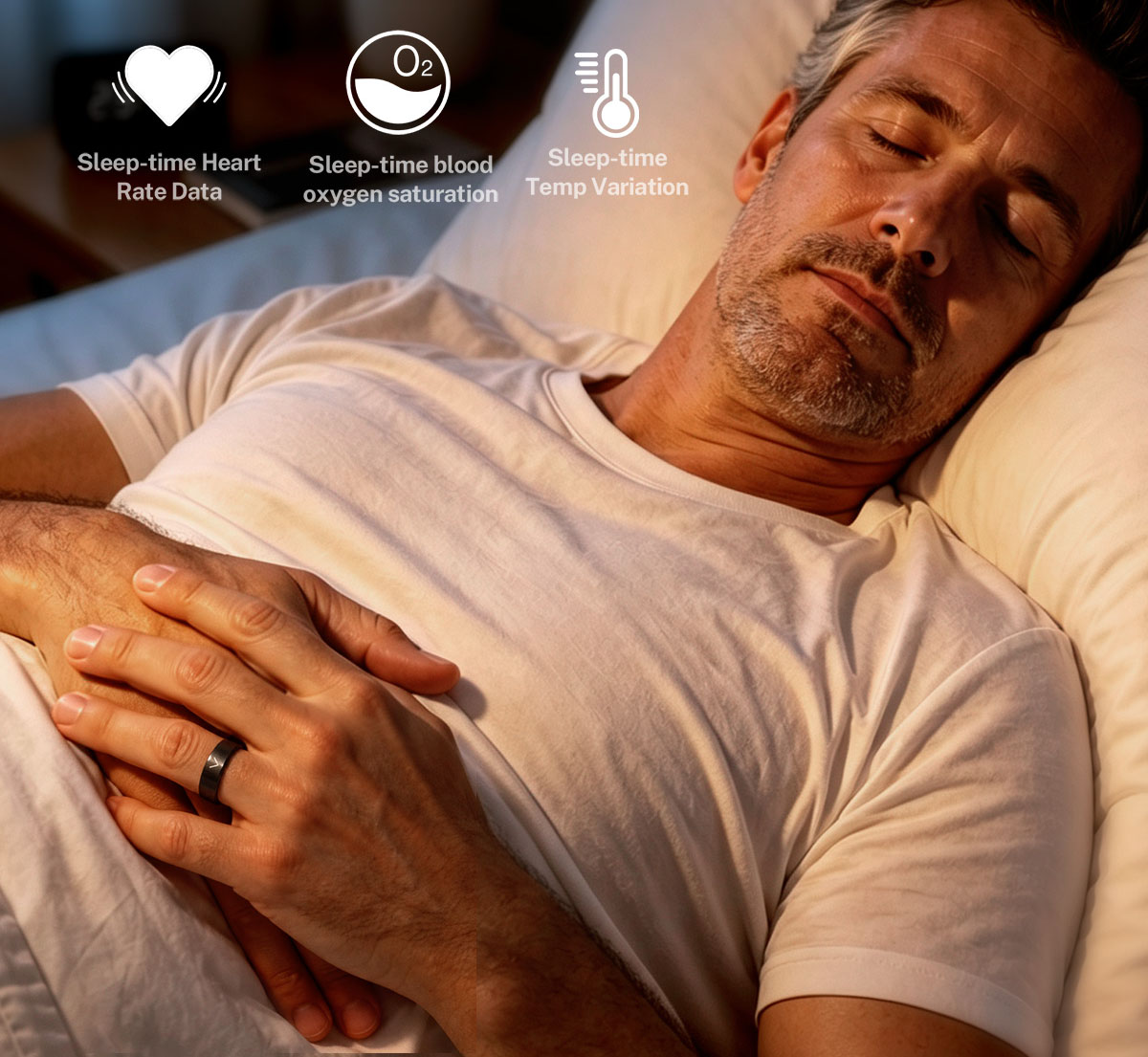
A smart ring, sometimes called a health ring or health monitoring ring, integrates miniature sensors into a small device worn on the finger.
Unlike a conventional smartwatch, a smart ring does not need a display. It gathers supported sensor information and transfers it to a compatible application where users can review their wellness data.
What Can a Health Monitoring Ring Track?
Depending on the hardware, algorithms, and companion application, a health tracking ring may support:
- Heart rate trends: Optical PPG sensors capture pulse-related signals.
- Sleep tracking: Motion and other supported sensor inputs can contribute to sleep-duration and sleep-pattern insights.
- Activity monitoring: Accelerometers detect movement and support everyday activity tracking.
- Skin temperature trends: Contact temperature sensors can help users follow changes relative to their personal baseline.
- Wellness insights: Compatible applications may organize supported measurements into everyday health and activity reports.
These functions make smart rings attractive for wellness-focused products, particularly where comfort and convenient overnight use are important.
However, sensor availability alone does not establish clinical accuracy or medical-device status. Brands should verify the actual measurement functions, algorithms, and validation evidence for their selected platform.
Why Smart Rings Appeal to Health and Wellness Brands
For a health technology brand, a smart ring offers several practical product advantages.
Discreet everyday wear
A compact ring can integrate into daily routines without requiring users to wear a conventional watch.
Screen-free experience
Users can review their information through an application rather than interacting with a display on the device itself.
Wellness product positioning
Health rings can support products centered on activity, sleep, recovery, and personal wellness awareness.
Private-label differentiation
Depending on the platform, brands may differentiate their products through materials, surface finishes, engraving, accessories, packaging, and compatible software experiences.
Example: LUROGEF CARE2 Smart Ring
The LUROGEF CARE2 Smart Ring provides an existing platform for wellness-focused OEM/ODM projects.
Its documented hardware includes:
- Titanium-alloy ring construction
- Optical PPG sensing
- Three-axis accelerometer
- Independent contact temperature sensor
- Bluetooth 5.1 connectivity
- Magnetic charging dock
The CARE2 platform is designed around supported wellness, pulse-related, activity, and relative skin-temperature trends.
It does not contain dedicated ECG, blood pressure, or glucose measurement hardware.
For businesses considering a private-label health ring, the CARE2 offers a starting point for discussing available product finishing, branding, sizing, and connected application requirements.
Explore: Smart Ring OEM/ODM Platforms
3. Blood Pressure Smartwatches: Dedicated Measurement in a Wearable Form
A blood pressure smartwatch serves a different primary purpose.
While many conventional smartwatches focus on fitness and activity, selected blood pressure watches incorporate dedicated hardware designed to measure blood pressure at the wrist.
It is important to distinguish between devices that use an inflatable cuff or airbag system and devices that estimate blood pressure through optical signals or software.
How Does an Oscillometric Blood Pressure Watch Work?
An oscillometric blood pressure watch uses an air pump and an inflatable component to apply controlled pressure around the wrist.
During the measurement process, the system analyzes pressure oscillations to estimate systolic and diastolic blood pressure.
This differs from ordinary optical PPG sensing, which detects light-based changes associated with blood volume.
A dedicated pressure-measurement mechanism does not, by itself, establish clinical accuracy. Performance depends on the complete device, wrist positioning, fit, measurement protocol, and supporting validation evidence.
Why Blood Pressure Watches Interest B2B Buyers
For healthcare technology companies and regional distributors, blood pressure watches offer several potential applications.
Home health monitoring
A wrist-based device can provide a wearable way to take blood pressure measurements according to a defined measurement procedure.
Connected health services
Compatible products may present supported measurements through a watch display or companion application.
Senior and family health products
Selected models combine a watch interface with communication, positioning, or SOS-related functions.
Digital health integration
Blood pressure wearables can be evaluated as measurement devices within connected health workflows, provided the intended use, data path, permissions, and applicable regulatory requirements are satisfied.
These opportunities require more than hardware selection. Businesses should also evaluate measurement validity, user training, data availability, and the exact intended use.
Example: LUROGEF Blood Pressure Watch Platforms
LUROGEF provides four oscillometric blood pressure watch platforms for OEM/ODM project evaluation.
| Model | Form Factor | Connectivity | Product Positioning |
|---|---|---|---|
| VC60 | Round display | Standalone 4G | Connected blood pressure watch with cellular functions |
| VC61 | Round display | Bluetooth companion | Blood pressure and connected health experience |
| VP20 | Rectangular display | Bluetooth companion | Slim wearable blood pressure watch |
| VP21 | Rectangular display | Standalone 4G | Blood pressure monitoring with cellular communication |
All four documented platforms use an air-pump and TPU airbag measurement architecture.
For B2B buyers, the key decision is not simply which watch has the most features. It is which platform matches the intended measurement workflow, preferred display, connectivity requirements, and target users.
Explore: Blood Pressure Watch OEM/ODM Products
4. Which Health Wearable Is Better for Your Business?
There is no single best wearable for every brand. The better choice depends on the business model and the value you want to deliver to customers.
Scenario A: Launching a Private-Label Wellness Brand
Recommended starting point: Smart Ring
If your target customers are interested in sleep tracking, activity awareness, and everyday wellness, a smart ring may offer a suitable product foundation.
For example, a wellness brand could build its offering around a lightweight ring, supported sleep and activity insights, a companion application, and branded accessories.
Before launch, the business should validate sizing, comfort, supported software features, and the wording of all health claims.
Scenario B: Building a Connected Blood Pressure Product
Recommended starting point: Blood Pressure Watch
If your product promise includes blood pressure measurement, a dedicated pressure-measurement platform is more appropriate than an ordinary wellness ring.
The project may involve choosing between Bluetooth and cellular connectivity, defining a measurement protocol, and confirming how users or authorized care teams will access results.
Any medical use or sale in a regulated market must be supported by the appropriate product-specific evidence and authorization.
Scenario C: Developing an Employee Wellness Programme
Recommended starting point: Depends on programme objectives
A smart ring may fit programmes centered on voluntary activity and sleep awareness.
A blood pressure watch may be considered when blood pressure measurement is a genuine programme requirement and the selected device is appropriate for the intended use.
For workplace deployments, businesses also need clear participant consent, privacy boundaries, and rules governing access to individual health information.
Scenario D: Expanding an Existing Health Wearable Portfolio
Recommended approach: Match each product to a distinct customer need
A distributor already selling connected watches could consider a smart ring as an additional wellness category.
Conversely, a smart-ring brand may evaluate a dedicated blood pressure watch when entering a different health monitoring segment.
This approach can provide a more coherent product portfolio than trying to make one wearable perform every measurement.
5. Can Smart Rings or Smartwatches Measure Blood Glucose?
Blood glucose monitoring is an important topic for businesses evaluating health wearable products.
However, a distinction must be made between a device that measures glucose and a device that displays glucose readings from a separate sensor.
Ordinary smart rings and smartwatches do not replace dedicated continuous glucose monitoring systems.
The U.S. FDA has warned against smartwatches and smart rings claiming to measure blood glucose on their own without piercing the skin.
Read the FDA safety communication on smartwatch and smart-ring glucose claims.
Where Continuous Glucose Monitoring Fits
A continuous glucose monitoring (CGM) system uses a dedicated glucose sensor to collect readings, which can then be transferred to compatible display devices or applications.
For example, the LUROGEF S10 platform uses a separate upper-arm glucose sensor. Compatible watches and applications display synchronized information rather than measuring glucose independently.
For businesses planning a glucose monitoring product line, the sensor system, device compatibility, validation documentation, and target-market registration requirements must be evaluated separately from ordinary wellness wearables.
Explore: CGM & Connected Monitoring Solutions
6. OEM vs ODM: How Should a Health Wearable Brand Start?
After choosing between a smart ring and a blood pressure smartwatch, the next decision is how to develop the product.
For B2B buyers, OEM and ODM manufacturing provide different levels of customization.
OEM and Private-Label Manufacturing
An OEM or private-label project typically starts from an existing product platform.
Depending on the model, possible customization may include product finishing, branding, accessories, packaging, or selected software elements.
This approach is often appropriate for businesses that want to work with an established hardware design rather than begin a completely new development programme.
However, available customization, minimum order quantities, costs, and delivery schedules should be confirmed with the manufacturer.
ODM Product Development
ODM development is appropriate when a business requires more substantial changes.
These may involve:
- Industrial design and structural changes
- Sensor or hardware configuration
- Firmware and software requirements
- User interfaces and watch faces
- Connected application functionality
- Branding and packaging
- Product testing and documentation requirements
The actual development scope depends on the selected platform, engineering feasibility, and commercial agreement.
Businesses should confirm ownership of design files, software, tooling, technical documentation, and relevant intellectual property before committing to an ODM project.
Learn more: LUROGEF OEM & ODM Health Wearable Manufacturing
7. Seven Factors to Evaluate Before Choosing a Health Wearable Manufacturer
Finding a health wearable manufacturer requires more than comparing product photographs and unit prices.
A reliable sourcing decision should consider seven areas.
1. Measurement Technology
Determine which sensors and measurement mechanisms the product actually contains.
Ask the supplier to explain the difference between directly measured values, calculated estimates, and software-generated wellness insights.
2. Product Validation and Quality Documentation
Request relevant test reports, technical specifications, quality-system documentation, and product-specific regulatory records.
A manufacturer's ISO 13485 certification is not equivalent to regulatory authorization for every product it manufactures.
For blood pressure products intended for the United States, verify the exact model's authorization status and intended use. The FDA has specifically warned about unauthorized wearable blood pressure devices.
3. OEM/ODM Customization Scope
Identify which elements can be changed without redesigning the core hardware and which require new engineering work.
4. Application and Data Connectivity
Confirm the supported Bluetooth or cellular functionality, compatible applications, available data fields, and integration options.
Do not assume an SDK, API, or cloud integration is available without written confirmation.
5. Product Comfort and Usability
For smart rings, evaluate sizing, overnight comfort, charging, and sensor contact.
For blood pressure watches, evaluate strap fit, airbag positioning, user instructions, and measurement workflow.
6. Manufacturing and Quality Control
Ask how the manufacturer manages component traceability, incoming inspection, assembly, firmware versions, functional testing, and production changes.
7. Commercial and After-Sales Support
Clarify sample availability, MOQ, quotations, tooling charges, lead times, warranty arrangements, spare parts, and software maintenance responsibilities.
These details can have a significant impact on the practical cost of launching and supporting a product line.
8. How to Evaluate Samples Before Placing a Bulk Order
Whether you are considering a smart ring or a blood pressure watch, a structured sample evaluation can reduce uncertainty before production.
A useful B2B evaluation should cover the following areas:
| Evaluation Area | Smart Ring | Blood Pressure Watch |
|---|---|---|
| Product fit | Ring sizing and sensor contact | Wrist fit and airbag positioning |
| Measurement review | Supported wellness trends and sensor behavior | Measurement procedure and validation evidence |
| Connectivity | Bluetooth pairing and synchronization | Bluetooth or cellular operation |
| Battery evaluation | Realistic daily and overnight use | Usage under the intended measurement and connection pattern |
| Application | Language, supported metrics, data presentation | Readings, timestamps, records, and user experience |
| Branding | Engraving, finish, charging accessories | Interface, case, straps, packaging |
| Quality review | Appearance, charging, durability | Pump operation, strap assembly, functional inspection |
A sample should be evaluated against a written product specification, not just whether it looks attractive or appears to work.
For a private-label project, request a sample configuration record and clarify whether the final production product will match the approved sample.
For products with regulated medical functions, internal sample testing does not replace the applicable clinical validation or regulatory authorization process.
9. Why Work With LUROGEF for Health Wearable OEM/ODM Projects?
LUROGEF is a Shenzhen-based health wearable manufacturer supporting product development and manufacturing for health technology brands, distributors, and connected health businesses.
Its product portfolio includes:
Smart Rings
The CARE2 titanium smart ring platform supports wellness-oriented product programmes built around PPG, motion, and contact-temperature sensing.
Blood Pressure Smartwatches
The VC60, VC61, VP20, and VP21 provide round and rectangular watch platforms with dedicated oscillometric blood pressure measurement hardware.
CGM & Connected Health
The S10 system provides a separate glucose sensor and compatible connected display experience for projects requiring continuous glucose monitoring.
LUROGEF offers OEM, private-label, platform customization, and ODM development services according to product and project requirements.
Its engineering background covers wearable product development, complete-device manufacturing, and applicable medical-device manufacturing capabilities.
For buyers, the starting point is a clear discussion of the intended user, required measurements, target sales market, customization scope, and documentation needs.
10. Frequently Asked Questions
Is a smart ring better than a smartwatch for health tracking?
It depends on the required function. A smart ring may be more suitable for discreet daily wear and wellness trends, while a smartwatch can provide a display and additional device functions. If blood pressure measurement is essential, the buyer should select a product with appropriate dedicated measurement hardware and verified performance.
Can a health monitoring ring measure blood pressure?
Most ordinary wellness smart rings do not contain dedicated blood pressure measurement hardware. The LUROGEF CARE2 smart ring does not measure blood pressure. Buyers should not interpret pulse-related PPG information as a verified blood pressure measurement.
Are sleep tracking rings suitable for private-label brands?
Sleep tracking rings can be a relevant category for private-label wellness brands. However, buyers should confirm the ring's documented sensors, available sleep-related software functions, sizing requirements, and measurement limitations before making product claims.
What is the difference between a blood pressure watch and a regular smartwatch?
A dedicated blood pressure watch includes hardware intended for measuring or estimating blood pressure. Conventional smartwatches may focus on fitness, activity, and pulse-related tracking. The precise measurement method, validation evidence, and regulatory status must be evaluated model by model.
Can I customize a smart ring or blood pressure smartwatch with my brand?
Yes. OEM and private-label projects may support branding, appearance, accessories, and packaging changes. More extensive hardware or software modifications may require ODM development. Actual customization options depend on the product platform and agreed project scope.
What should I request from a health wearable OEM manufacturer?
Request product specifications, available samples, measurement and validation documentation, model-specific regulatory records, customization details, pricing, MOQ, lead time, quality-control information, and after-sales responsibilities.
Conclusion: Choose the Health Wearable That Fits Your Brand Strategy
Smart rings and blood pressure smartwatches are not interchangeable products.
A smart ring can be a strong foundation for a wellness-focused product offering centered on discreet wear, supported sleep and activity tracking, and personal health awareness.
A blood pressure smartwatch may be a more appropriate option when the product requires dedicated wrist blood pressure measurement, an on-device interface, or selected connected monitoring functions.
For companies entering the health wearable market, long-term product value begins with choosing the right measurement technology, defining realistic product claims, and working with a manufacturing partner that understands the intended application.
Start Your Health Wearable OEM/ODM Project With LUROGEF
Are you planning to launch a private-label smart ring, develop a blood pressure smartwatch, or expand your connected health product portfolio?
LUROGEF can help you evaluate its available wearable platforms and discuss an OEM/ODM development path based on your project requirements.
Share your target market, preferred product type, expected order quantity, and customization needs to begin a technical and commercial discussion.
Contact LUROGEF to Discuss Your Project
Explore our product platforms: