How to Read a Health-Wearable Manufacturer’s Quality Documents
A supplier sends you a folder. In it are a production licence, a certificate with a standards number on it, and perhaps a patent. All three say something reassuring. None of them says what most buyers think it says — and the gap between what they prove and what they appear to prove is where procurement mistakes live.
This guide is written so that you can apply it to any supplier, including the one whose site you are reading. It classifies the documents by what they actually establish, shows how to read a scope line, and gives you a written ask-list to put to whoever is selling to you.
The three document classes — and why they are not interchangeable
Almost every document pack a health-wearable manufacturer sends you belongs to one of three classes. They are issued by different bodies, they answer different questions, and confusing them is the most common error in a supplier review.
| Production licence | QMS certificate | Market authorization | |
|---|---|---|---|
| What it is about | A facility and a device category | A management system | A specific device in a specific market |
| Who issues it | A national regulator | A third-party certification body | A market regulator |
| What it proves | The named facility may manufacture devices in the stated scope category, for the stated period | The management system conforms to a published standard, within the boundaries the certificate states | This device may be placed on this market, by this holder, subject to the terms of the authorization |
| What it does NOT prove | That any product is authorized anywhere, or that measurements are accurate | That any product is registered, or that a measurement has been validated | That the device is accurate in your population, or that it suits your intended use |
| Scope machinery to look for | Scope category · validity window · production address | Standard · scope text · certificate number · validity window · operation address | Device identity · class · market · holder · conditions |
| Failure mode when confused | Read as a product approval, so the market-authorization question is never asked | Read as an accuracy demonstration because the words “medical device” appear on it | Assumed to exist because the other two do, and the product reaches a border without it |
The third column is the one buyers most often assume they already have. A production licence and a QMS certificate are factory and process documents: they describe where something may be made and how the process is governed. A product market authorization is the only one of the three that permits a product to be placed on a market — and it is device-specific and market-specific, so one product authorized in one territory says nothing about the next territory.
If you remember one sentence: a production licence and a quality-management-system certificate are factory and process documents with a bounded scope. They are not product authorization, and they do not prove clinical accuracy — and neither does a patent.
How to read one certificate: six things to look at, in order
The same six checks apply to a production licence, a QMS certificate or a market registration. Run them in this order, because each one narrows what the next one has to prove.
The holder line
Whose name is on it? It should be the entity you will contract with. If it is a different entity, you need the relationship between them documented — not explained verbally, and not left as an assumption that “it is the same group”.
The address — both of them
Certificates commonly carry a registered address and a separate operation or production address. The operation address is the one that should line up with where your product is actually made. A registration address alone tells you where the company is registered, not where the work happens.
The scope text
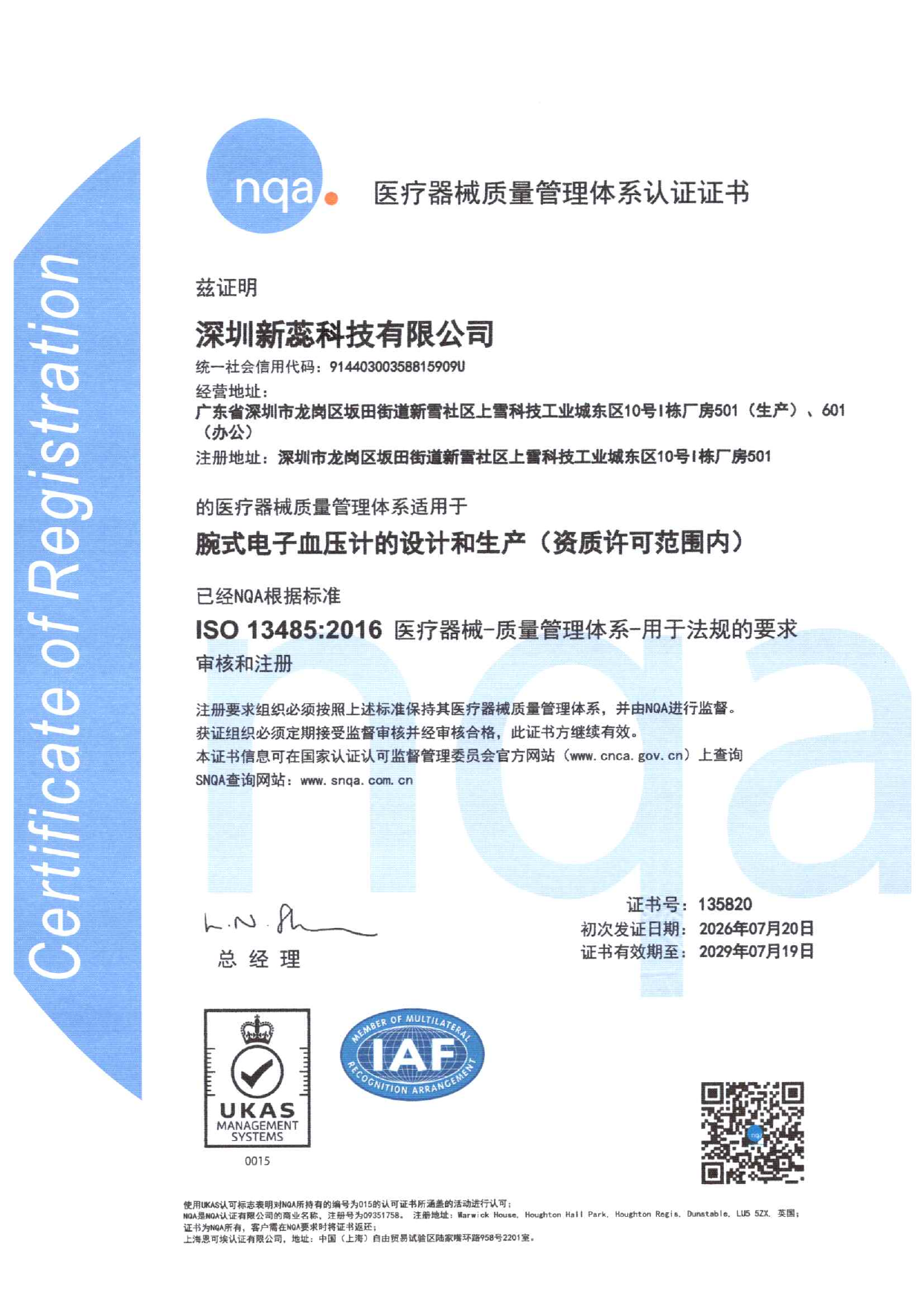
Read the scope line as written, not as summarized. “Design and production of wrist electronic blood pressure monitor, within the scope of the qualification licence” is a materially narrower statement than “medical device manufacturer”, and the narrower one is the true one.
The scope category
Licences and registrations are usually issued per category or class. Check that the category covers the activity and the device type you are buying — not merely the industry.
The validity window
A certificate has a start and an end. Check the end date against your purchase, your launch and your warranty horizon — and be aware that a certificate may be issued before the period it covers.
Verification out-of-band
Use the issuing body’s own public register, not the copy you were sent. A certificate number plus a queryable register is what turns a scan into a checkable claim. A scan you cannot query is a picture.
Two of those steps are worth dwelling on. The scope text is where certificates are most often overstated — not by the issuing body, but by the summary a sales team builds on top of it. And out-of-band verification is what separates a document from a picture: a certificate number is only useful if there is a register you can query it against, and that means the issuing body’s own register, not the scan you were sent.
The accuracy question: the fourth category nobody sends you
Buyers arrive at a wearable supplier asking “is it accurate?” and receive a folder of certificates. That folder cannot answer the question, and knowing why is what stops a compliance problem from becoming a marketing promise.
Accuracy is a separate category of evidence
Analytical and clinical performance is established by device-specific studies, in a stated population, against a stated reference method. That is a fourth category of record, and none of the three document classes above contains it.
“Medical device” on a certificate is a category word, not a performance word
It says which regulatory category a product or facility sits in. It does not say the measurement is right, and it does not say how close it is.
A patent sits outside all three classes
A patent is an intellectual-property record. It is not proof of clinical accuracy and it is not regulatory authorization. See one named on a company page and you are looking at inventiveness, not validation.
Directive conformity is not medical approval
RoHS and RED records address named directives for named models. They are not EU MDR certification and they are not FDA clearance, and neither directive is a medical-device authorization route.
Ask for the fourth category by name
If you need an accuracy claim, ask for the validation or clinical record for that specific device. A supplier who cannot produce one is telling you something useful. A supplier who implies one from a certificate is telling you something more useful still.
One practical consequence: put the accuracy question in writing, separately, and ask for the record by name. If it does not exist, that is a finding — a plan you have to build around, not a disqualification. What is actually disqualifying is a supplier who lets a certificate imply an accuracy claim it cannot support, because that supplier has just handed you a claim you will repeat to your own customers and your own regulator.
The written ask-list: seven questions, and the document that answers each
Understanding the classes is not the same as running a review. This is the list to paste into your RFQ or your supplier-audit email — and the fourth column is the reason each ask is on the list at all.
| # | Ask for this, in writing | Which document answers it | What makes the answer worth a follow-up |
|---|---|---|---|
| 1 | The production licence number and its scope category | The production licence | If the category does not cover the device type you are buying, the licence is not the answer. |
| 2 | The QMS certificate number, standard, scope text and validity window | The QMS certificate | If the scope text is broad and generic while the licence is narrow, trust the narrow one. |
| 3 | The certification body, and how to query it independently | The QMS certificate | A body you cannot query is a body you cannot check. |
| 4 | Whether the certificate’s operation address matches the entity you will contract with | Both documents | A mismatch is not automatically disqualifying — it is automatically a question. |
| 5 | Which specific device and which specific market the seller is authorized to place on the market, and by whom | The market authorization | “We are certified” is not an answer to this question. Ask for the document or a written statement that none exists. |
| 6 | Whether any accuracy or clinical record exists for that specific device | The fourth, separate category | Expect this to be separate from everything above. If it is implied from a certificate, that is a warning sign. |
| 7 | Which party holds the market-facing duty in your territory | Your own advisers | For most markets this lands on the party placing the device on that market. Confirm it for your territory rather than assuming. |
The same standard, applied to this company
A guide that teaches a standard and then declines to apply it to its own publisher is a marketing page. So here is every document we state on our About Us page, classified against the standard above — including the row that says what we do not hold.
| Document we state | Class | Scope as recorded | What it does not prove |
|---|---|---|---|
| Medical-device Production Licence · Guangdong Medical Device Production Licence No. 20255660 | Production licence | Class II category 07 scope; valid 2025-01-06 to 2030-01-05 | A facility document. It does not authorize any product in any market, and it is not evidence of measurement accuracy. |
| Medical Device Quality Management System Certification · ISO 13485:2016 · certificate 135820 | QMS certificate | Scope bounded by the qualification licence: wrist electronic blood pressure monitor design and production; valid 2026-07-20 to 2029-07-19 | A management-system document. It does not establish product registration, clinical validation, or a general medical-grade claim across the portfolio. |
| Specialized, Sophisticated, Unique and Innovative SME | None of the three — an enterprise-status designation | Valid 2024-12-31 to 2027-12-30 | An enterprise designation. It says nothing about product authorization, measurement accuracy or clinical performance. |
| Invention patent · ZL 2023 1 1428145.7 / CN 117379017 B | None of the three — an IP record | Grant announcement 24 May 2024 | Inventiveness, not validation. A patent is not proof of clinical accuracy or regulatory authorization. |
| RoHS and RED VoC records for XC-VP20 and XC-VC61 | None of the three — directive conformity records | Named models, within stated directive scope | Not EU MDR certification and not FDA clearance. |
| Product market authorization | The third class | None held on the evidence available | We hold no product market authorization or registration for any product we build. If your market requires one, that is a step your project has to plan for. |
The row worth reading twice: we hold no product market authorization or registration for any product we build, on the evidence we have. That is not a footnote — it is the answer to a question a distributor will be asked by its own customers, and it is better learned here than after a listing is committed.
Two further things are worth stating plainly, because a document review will raise them. First, certificate scans on this site are originals shown unchanged — cards carry the certificate title only, the holder printed on the document is never reassigned, and no additional claim is written around the scan. Second, these transcriptions are what the records show; they are not a registry verification, and we do not pretend otherwise. Verify them out-of-band, using the issuing body’s own query route — that is exactly what step six of the reading method above tells you to do with any supplier, and it applies here with no exception.
The fuller treatment of these documents, with their scopes retained, sits on the certifications route. Where each document is actually produced in a project — and why a facility certificate never covers an individual product — is the subject of From Development to Production: Building a Watch.
Key takeaways
- A production licence and a quality-management-system certificate are factory and process documents with bounded scope — not product authorization, and not proof of accuracy.
- A product market authorization is the only class that permits a product onto a market, and it is device-specific and market-specific.
- Accuracy is a fourth, separate category. Ask for the validation or clinical record for the specific device, by name.
- A patent is not validation, and RoHS/RED are not EU MDR certification or FDA clearance.
- Read the scope text, the scope category, the validity window and both addresses — and verify the number against the issuing body’s own register, not the scan.
- Put the seven asks in writing and keep the answers in a folder you assembled yourself.
Frequently Asked Questions
Questions buyers usually need answered first
Practical answers about product selection, everyday use and planning your project.
Visit the FAQ pageWhat is the difference between a production licence and an ISO 13485 certificate?
They are different classes of document issued by different bodies for different purposes. A Medical-device Production Licence is issued by a national regulator and authorizes a facility to manufacture a stated device category — it carries a scope category and a validity window, and it is about where and what you may make. An ISO 13485:2016 certificate is issued by a certification body and attests that a management system conforms to the standard — it is about how you run the process, and it is normally limited by the licence scope rather than extending beyond it. Neither one authorizes a product to be placed on a market: that is a third class of document, a product market authorization or registration, which is device-specific and market-specific. Reading them as one class is the most common error in a supplier document review.
The certificate says “medical device” — doesn’t that mean the measurements are accurate?
No, and this is the single most consequential misunderstanding in the category. None of the three document classes establishes measurement accuracy or clinical validation. A management-system certificate says the process conforms to a standard; a production licence says the facility may manufacture the category. Accuracy evidence is a fourth, separate category — clinical or validation records for a specific device, in a stated population, against a stated reference method — and it is the one category the first three will never contain. If you need an accuracy claim, ask for that fourth category by name, for that specific device. A supplier who cannot produce it is telling you something important, and a supplier who implies it from a certificate is telling you something more important still.
What exactly should I ask a supplier for, in writing?
Seven asks, each of which maps to a document that answers it. (1) The production licence number and its scope category. (2) The QMS certificate number, standard, scope text and validity window. (3) The certification body, and how to query it independently. (4) Whether the certificate’s operation address matches the entity you will be contracting with. (5) Which specific device and which specific market the seller is authorized to place on the market, and by whom. (6) Whether any accuracy or clinical record exists for that specific device. (7) Which party holds the market-facing duty in your territory. Ask for them as documents rather than as assurances, and put the answers in the file — a folder you assembled yourself is worth more than a pack someone sent you.
How do I check that a certificate actually belongs to the company I am dealing with?
Match three things, in writing. First, the holder line: the name on the certificate should be the entity you will contract with, or you should have a documented explanation of the relationship between them. Second, the address: certificates carry a registered address and often a separate operation or production address, and the operation address is the one that should line up with where your product is actually made. Third, the scope: the certificate’s scope text and category should cover the device and the activity you are buying, not merely the industry. Then verify the certificate out-of-band, using the issuing body’s own query route rather than the copy you were sent — a certificate number and a certification body’s public register are what make a scan checkable. A scan you cannot query is a picture.
How should I review model-specific conformity records?
Check the exact model identifier, certificate holder, applicable standards, issue date and document type. Our certificate portfolio includes RED and RoHS records for XC-VC61 and XC-VP20; review each record against the configuration and territory you plan to sell in.